
Opportunities for Foreign Companies in Japan
How the yen and monetary policy affect investment and operating costs
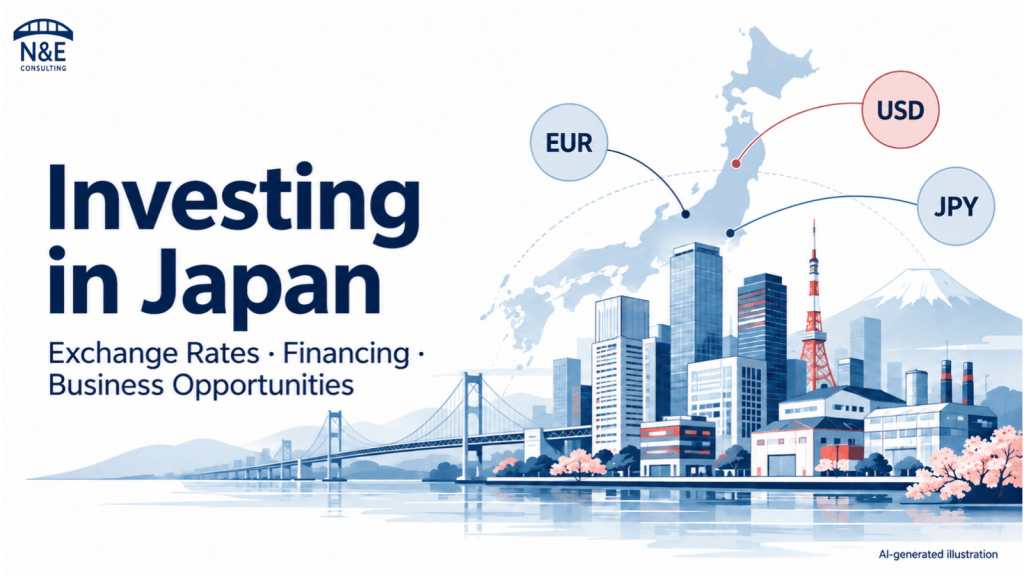
Exchange rates can materially change the capital required to establish or expand a Japanese operation. A company funding investment in Euros (EUR) or US Dollars (USD) may gain additional purchasing power when the Japanese Yen (JPY) weakens. Businesses earning overseas revenue while incurring costs in Japan can also benefit. The commercial effect depends on how funding, expenditure and sales are distributed across currencies.
The economic position in September 2026
On 18 September 2026, the Bank of Japan decided to raise its target for the uncollateralized overnight call rate to around 1.25%, effective from 24 September. It nevertheless expected financial conditions to continue supporting economic activity after the increase. The Bank also indicated that further rate increases would depend on developments in the economy, prices and financial conditions. [1]
Its assessment describes a moderate economic recovery and rising business investment, alongside pressure from energy prices and construction costs. This combination matters for foreign businesses: investment activity can create commercial opportunities, while higher local prices can absorb part of a currency advantage. [1]
Monetary policy and exchange rates are connected, but they affect a business through different channels. Interest rates influence financing costs; exchange rates change the value of payments and receipts across currencies. A rate decision alone does not determine the yen’s direction, which also reflects overseas interest rates and market expectations.
Where the yen can increase investment capacity
The Bank of Japan’s market observations at 17:00 JST on 24 September 2026 put the USD at approximately ¥158.2 and the euro at approximately ¥180.3. These are dated market observations; a company’s actual conversion rate will depend on its provider and transaction terms. [2]
For a foreign parent company, a weaker JPY reduces the home-currency cost of a fixed JPY budget. This can affect expenditure on a local office, services, equipment purchased in yen and the initial costs of building a team. The benefit is clearest where the underlying yen price remains unchanged.
An illustrative ¥30 million budget would require €200,000 at ¥150 per euro, compared with approximately €166,667 at ¥180 per euro. That is about 16.7% less capital in EUR for the same JPY expenditure.
For USD funding, the same ¥30 million budget would require approximately US$214,286 at ¥140 per USD, compared with US$187,500 at ¥160 per USD. This represents a 12.5% reduction in the USD funding requirement. Both examples use hypothetical comparison rates, excluding conversion fees and any change in local prices.
A company could use that difference to reduce its initial funding requirement or increase the resources available for its Japanese operation. Rising salaries, rents or supplier prices would reduce the saving, while a stronger yen would increase the cost of later funding transfers.
The effect depends on the business model
Foreign ownership alone does not create an exchange-rate benefit. The following examples show how a weaker yen can affect different activities, assuming unchanged underlying prices and before any currency hedging.
| Business model | Potential effect of a weaker yen |
| Local investment funded in EUR or USD | A fixed amount of overseas funding buys more yen, increasing capacity for yen-denominated expenditure. |
| Production or services in Japan with overseas revenue | Foreign-currency sales translate into more yen against local costs. Imported inputs can offset part of the benefit. |
| Imported goods sold to Japanese customers in JPY | Purchases priced in foreign currencies cost more in yen, potentially reducing margins unless selling prices adjust. |
| Local sales and local costs mainly in yen | Direct operating exposure may be limited, but yen profits convert into fewer euros or dollars when remitted overseas. |
The distinction between funding an operation and receiving its profits is particularly relevant. A favourable exchange rate at entry can reduce the initial investment, while a weak yen at a later date can reduce the parent company’s return in its reporting currency. Both belong in the same investment assessment.
What the interest rate environment means for financing
The Bank of Japan’s description of supportive financial conditions provides context for evaluating local financing. Its policy target is an overnight market rate, rather than the interest rate available to an individual company. [1]
Actual loan pricing and approval depend on the lender’s assessment and the terms of the transaction. A foreign-owned company therefore needs a financing proposal specific to its business before translating the wider interest rate environment into a cost advantage.
The currency of debt also matters. JPY borrowing can align debt service with yen receipts, while borrowing in another currency introduces an additional exposure if repayment depends on Japanese revenue. Comparisons between local borrowing and overseas funding should include fees, repayment terms and any hedging costs. Rising rates also affect the future cost of variable-rate borrowing and refinancing.
The wider commercial case for Japan
JETRO’s 2025 Survey on Business Operations of Foreign-affiliated Companies in Japan provides evidence of continued interest in expansion. Published in February 2026 and based on responses from 1,520 companies collected in September and October 2025, it found that approximately 60% intended to strengthen or expand their Japanese operations. Respondents particularly valued stability and the presence of customers and related industries. These findings describe established businesses’ priorities before the latest monetary policy decision. [3]
The AHK Japan and KPMG survey German Business in Japan 2026 adds the perspective of German subsidiaries. In its main survey of 175 companies, conducted from 30 January to 12 February 2026, 91% of respondents reported a profit in Japan in 2025, while 68% expected sales growth in 2026. These findings support a commercial case based on operating performance and demand alongside any currency advantage. [5]
JETRO’s Invest Japan Report 2025 also highlights investment in data centres and logistics facilities linked to demand for AI infrastructure, automation and labour-saving operations. For suppliers serving these activities, this suggests areas to examine for customer demand and partnerships. These are sector opportunities with their own commercial drivers, separate from the exchange-rate benefit. [4]
Capacity constraints remain relevant to those opportunities. The JETRO business survey found that 44.5% of respondents faced difficulties securing personnel. A budget that converts favourably into yen still needs to reflect the availability and cost of the people required to deliver the business plan. [3]
Applying the opportunity to a Japanese operation
For companies already considering investment in Japan, currency conditions can create additional room to establish a local team, develop customer relationships or expand an existing operation. The size and durability of that advantage depend on the timing of funding, the proportion of costs incurred locally and the currencies in which revenue is earned.
A useful commercial assessment brings the initial investment and ongoing cash flows together under several exchange-rate and financing assumptions. This makes it possible to identify which advantages come from the current financial environment and which come from the business itself.
N&E Consulting supports international companies with market entry, company establishment and the coordination of operations in Japan. If you are evaluating a Japanese presence or expanding an existing business, we can help connect your commercial objectives with the practical requirements of operating locally.
Sources
[1] Bank of Japan — Change in the Guideline for Money Market Operations
18 September 2026. Policy decision and economic assessment, pages 1–4.
[2] Bank of Japan — Foreign Exchange Rates
24 September 2026. Rates observed at 17:00 JST, page 1.
[3] JETRO — 2025 Survey on Business Operations of Foreign-affiliated Companies in Japan
February 2026. Survey period 25 September–31 October 2025. Methodology on page 3 and findings on page 9.
[4] JETRO — Invest Japan Report 2025
Key points of the report, based on information available as of September 2025 and investment developments in 2024.
[5] AHK Japan and KPMG — German Business in Japan 2026
AHK Japan publication dated 27 April 2026. Main survey of 175 Japanese subsidiaries of German companies, conducted 30 January–12 February 2026.
Sources checked on 25 September 2026. Business interpretations and the hypothetical calculations are by N&E Consulting.