
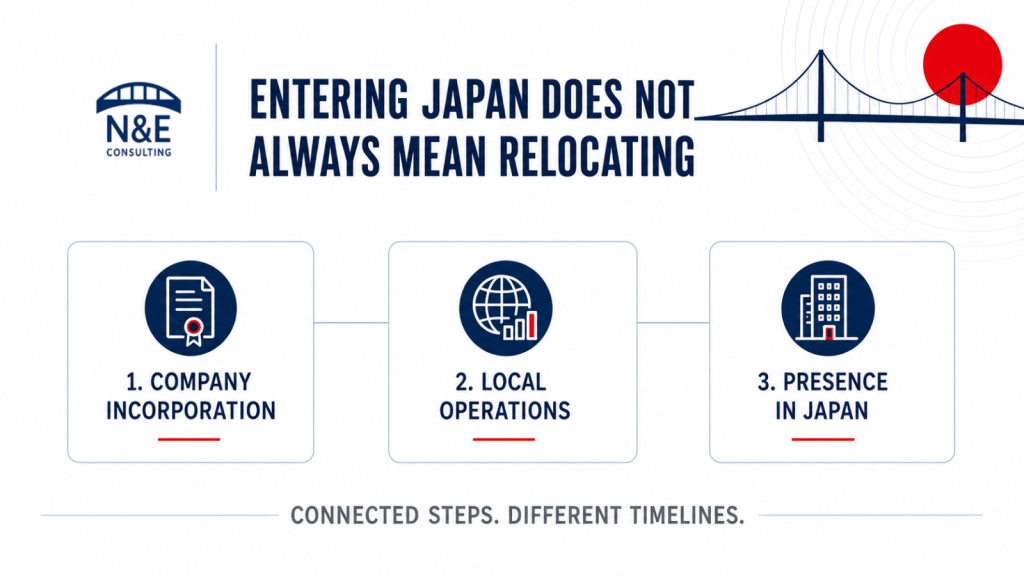
Entering Japan: Building a Business While Management Remains Abroad
Entering the Japanese market does not always require founders or management to relocate immediately. A company may first need to understand customer needs, develop partnerships or establish a Japanese entity while its existing team continues to work from abroad.
Incorporation, local operations and the decision to live and work in Japan are connected, but they can follow different timelines. Planning them together helps identify what the business needs now and what should be prepared for a later stage.
The starting point is simple: which activities does your business need to carry out in Japan?
Start with the business needs
A company exploring demand needs a different setup from one preparing to hire employees or deliver services on site. Before choosing a structure, clarify:
- Are you still researching the market, or preparing to start commercial operations?
- Do customers or partners need to contract with a Japanese company?
- Which tasks require someone in Japan, and who will handle them?
- Will founders, management or employees need to work in Japan later?
These answers help determine the first steps and the conditions for expanding your presence.
Choose an approach that fits your current stage
Explore the market and develop partnerships
Customer interviews, trade fair visits and discussions with potential distributors or service partners can help establish whether a dedicated Japanese operation makes commercial sense.
For any partnership, clarify who contracts with customers, delivers the product or service, and handles local enquiries. Before sales or on-site activities begin, check the registration, tax and regulatory requirements that apply to the arrangement.
A representative office is another option for preparatory activities such as market research and information gathering. It cannot engage in sales, so it serves a different purpose from a branch or subsidiary. JETRO: Types of operation in Japan
Establish a Japanese company while management remains abroad
A Japanese company may be appropriate when the business needs a local entity to sign customer contracts and support further growth.
For a Kabushiki Kaisha (KK) or Godo Kaisha (GK), company registration rules do not require the representative director or representative member to reside in Japan. Founders and management can therefore, in principle, remain abroad during incorporation. A branch of a foreign company has a different rule: at least one representative must reside in Japan. JETRO: Comparison of types of business operation
The ability to register the company is one consideration. Making its daily operations work is another.
Build a team and reliable contacts in Japan
Depending on the business model, local employees, management or external partners may support operations while the overseas team stays at its existing base.
Define who handles customer communication, suppliers and documents, and who decides when an urgent issue arises. Give each person the authority needed for their role. Outsourcing administration does not automatically transfer management responsibility to the service provider.
Prepare incorporation and operations together
Documents and capital contribution
When the founders or parent company are abroad, confirm which documents must be obtained there and whether signature certification, notarization or Japanese translations are needed. The requirements depend on the structure and the parties involved.
The capital contribution also needs advance planning. For a KK, it is paid before registration, when the new company does not yet have its own corporate account. Confirm the permitted receiving account, account holder and evidence of payment for the chosen procedure. This is separate from opening the company’s operating account after incorporation. JETRO: Procedures for registering establishment
Banking and payments
Incorporation does not guarantee a corporate bank account. Banks apply their own screening and may review the business, beneficial ownership, financial condition and purpose of the account. Requirements differ, and applications can be declined. JETRO: Opening of corporate bank accounts
Check the proposed bank’s requirements for the representative and application contact early. Prepare evidence of the planned business and allow time for questions. Also identify the payment functions you need, including domestic collections, supplier payments and international transfers.
Address, administration and budget
Choose an address arrangement that supports the planned activities. Consider who will receive and act on correspondence, whether meeting or workspace is needed, and how the arrangement fits banking requirements and any future immigration plans.
Budget for the period between incorporation and stable revenue, including office services, accounting, administration and planned staffing. Assign someone to coordinate these tasks so that overseas management can keep track of deadlines and costs.
Who needs to work in Japan—and when?
Owning or establishing a Japanese company does not itself grant permission to live and work in Japan. Immigration planning depends on the individual and their actual duties. Work-related statuses distinguish between activities such as business management, specialist employment and qualifying intra-company transfers. Eligibility must be assessed for the proposed role. JETRO: Types of working statuses
Short business visits are a separate matter. Meetings, negotiations and certain market research activities can fall within Temporary Visitor status. It does not provide general permission to work or operate an income-generating business in Japan, so check the planned activities before travelling. JETRO: Temporary visitor visa and status of residence
If a future transfer is likely, assess its feasibility during the initial planning. The person may arrive later, but their duties, employment arrangements and the local setup can affect that step.
What a phased approach could look like
An overseas software company might start with customer interviews and potential partner discussions while its product team remains abroad.
If a Japanese entity becomes commercially necessary, it could prepare incorporation alongside its address, banking and local support. It would also decide who handles Japanese customer enquiries and how they reach the overseas team.
A later staff transfer could respond to a defined need, such as technical coordination or customer support, subject to the appropriate immigration assessment.
This is one possible sequence. Other businesses may need local personnel or dedicated premises from the outset. The timing should follow the work that needs to be done.
Plan the next step around your business
How much presence you need in Japan depends on your business model and stage of development. Agree what must be in place before launch and what would justify expanding the team or bringing management to Japan.
N&E Consulting supports international companies with Japan entry, from incorporation and operational setup to preparing for a later stay and addressing visa and residence matters when needed. We work in English, German and Japanese to coordinate the steps around your business plans.
Planning your entry into Japan? Contact N&E Consulting to discuss the structure and next steps that fit your business.