
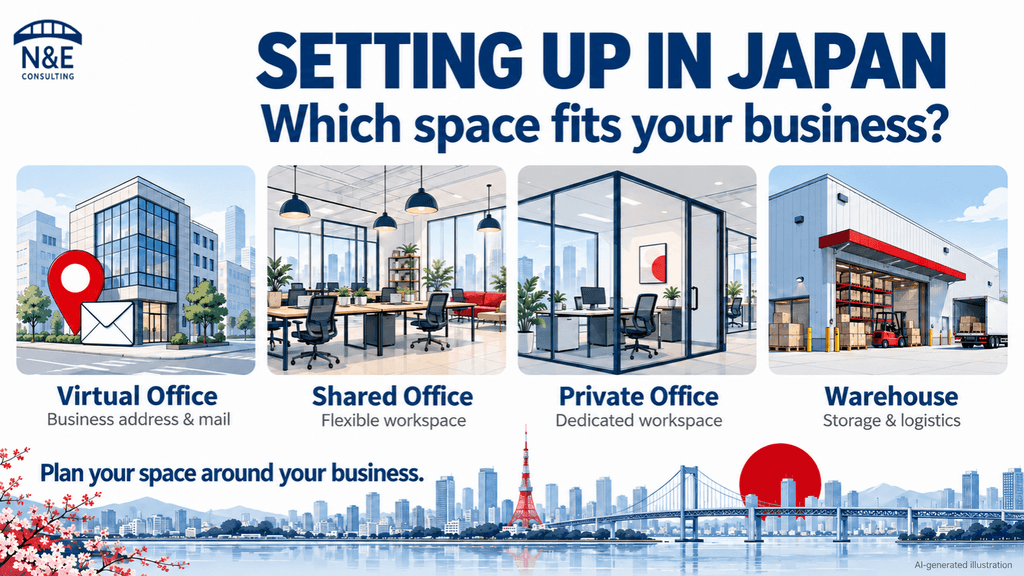
Choosing Office and Warehouse Space for Your Company in Japan
When setting up a company in Japan, one of the first practical decisions is choosing a business address and the space your operations need. A remote service business may have very different requirements from a local sales team or a company importing and distributing products.
A virtual office, shared workspace, private office or warehouse can each serve a useful purpose. The right combination depends on how you will work, the commitments you can afford and any requirements linked to your activities. JETRO includes office selection in its business setup guidance because the address matters across registration, banking and other procedures. [1]
Virtual offices for businesses that work elsewhere
A virtual office provides an address and selected administrative services without a permanent workspace for your team. Depending on the provider and plan, services may include company registration at the address, mail handling, telephone services and access to meeting rooms. Check exactly what is included. [2]
We would consider this option for a business whose work can be carried out remotely or at client locations, provided its banking and licensing needs are compatible with that arrangement. It can keep initial commitments manageable while providing an address separate from a founder’s home.
Before signing, confirm that the selected plan permits company registration. Ask how official letters and parcels are handled, how quickly you are notified and whether overseas forwarding is available. For founders based outside Japan, reliable access to correspondence deserves as much attention as the monthly fee.
Shared offices for regular access to a workplace
Shared offices and coworking spaces provide physical workspace, but the terms describe a wide range of arrangements. A hot desk in an open area is different from a dedicated desk or an enclosed office in a serviced building.
For a small team, we would compare these options based on attendance, meeting frequency and privacy. A space that works well for occasional laptop use may be unsuitable for confidential calls, equipment storage or daily client meetings.
Ask whether registration is included, whether a particular space is assigned to your company and which access hours apply. Include meeting room charges, additional users and storage in the comparison. If a permit or residence application depends on the premises, have the specific space and contract reviewed before committing.
Private offices for a permanent operating base
A private office is worth considering when your team needs consistent access, confidential meeting space or room for equipment and demonstrations. A private room in a serviced office and a conventional lease can both provide dedicated space, with different levels of setup work and flexibility.
For a conventional lease, budget beyond the monthly rent. JETRO’s cost guidance identifies security deposits, brokerage fees and office equipment among the initial expenses. Actual costs depend on the property and contract, so request a complete quotation. [3]
Review the permitted use, service charges, fit-out arrangements, renewal terms and notice period. Clarify what must be restored when you leave. If you plan to demonstrate products, carry out repairs or receive frequent deliveries, describe those activities to the landlord before signing.
Warehouses and fulfillment for physical products
If you sell physical products, plan how goods will be received, stored and dispatched alongside your office decision. An office and a warehouse serve different functions, and your stock does not necessarily need to be kept where your team works.
Leasing storage space may make sense when you need direct access to inventory, regular inspections, repairs or special handling. Assess delivery access, security, environmental conditions and the space required for packing and returns. Confirm that the premises and contract permit the intended activities.
An external logistics or fulfillment provider is another option. Depending on the service, a provider can store goods and handle order picking, packing, shipping and returns. Yamato Transport, for example, describes an EC logistics service covering storage, shipment and returns management. [4]
We would compare the full operating cost at realistic order volumes, including receiving fees, storage, packaging, dispatch and returns. For products with special handling requirements, check the provider’s capabilities and clarify who is responsible for any necessary approvals.
For an initial market launch, a small office or suitable virtual office combined with outsourced fulfillment may be worth evaluating. Your administrative address, workplace and stock location should each be chosen for the role they need to perform.
A practical comparison
| Option | Potential fit | Key point to check |
| Virtual office | Remote operations with limited physical needs | Address use and reliable mail handling |
| Shared office | Individuals or small teams needing workspace | Privacy, access and the exact plan |
| Private office | A regular team base or dedicated equipment | Total lease costs and permitted activities |
| Warehouse or fulfillment | Stockholding and product distribution | Handling needs and total logistics costs |
Check registration and operating requirements separately
Permission to register a company at an address does not establish that the same arrangement will satisfy every other requirement. Review the following points while comparing premises.
Bank account opening
A virtual office does not automatically prevent a company from opening a Japanese bank account. GMO Aozora Net Bank explains that this is possible, while noting that banks differ in their policies and screening. Acceptance of an application is not a guarantee of approval. Prepare a clear explanation of the business and the supporting documents requested by the bank. [5]
Mail delivery also matters. GMO Aozora states that its debit cash card is sent to the registered company address by registered mail marked not to be forwarded. Confirm how the bank’s delivery requirements and the office provider’s receipt procedures fit together. [6]
Licenses and permits
Some activities require permits or approvals before operations begin, as JETRO’s setup guidance explains. [1] Where your activity has premises requirements, check the proposed layout and use with the relevant authority or adviser before signing. A provider’s general statement that company registration is allowed does not answer that question.
Residence status
If your plans involve the Business Manager status of residence, office selection needs a separate assessment. Immigration Services Agency guidance requires premises for ongoing business operations and addresses the contractual right to use them. [7] On that basis, an address-only service should not be treated as meeting the office requirement. Have any shared or serviced office arrangement assessed on its actual space, contract and use; the marketing label alone is insufficient.
Plan the first year before signing
Map out how the business will operate over the next twelve months. Estimate how often people will work on site, how many client meetings you expect and how much stock you will hold. Then compare the full cost of each suitable arrangement, including deposits, optional services and exit costs.
If the company has not yet been incorporated, ask who can sign the initial agreement and how it will be transferred to the company afterwards. Also consider what a later move would involve, including updating the registered address and notifying banks and other relevant parties.
At N&E Consulting, we support international companies with company formation and the practical arrangements around starting operations in Japan, including virtual office coordination and bank account support. If you are planning your launch, contact us to discuss how your address and workspace choices fit into the wider setup process.
Sources
[1] JETRO — Model Case Commentary on Business Setup
[2] One Stop Business Center — Virtual office services and facilities
[3] JETRO — Cost Estimation for Setting Up Business
[4] Yamato Transport — EC Logistics Services
[5] GMO Aozora Net Bank — Corporate bank accounts when using a virtual office
[6] GMO Aozora Net Bank — Corporate account opening and delivery procedures
[7] Immigration Services Agency of Japan — Guidance on the Business Manager status and business premises
Sources reviewed on 5 October 2026. Japanese-language source titles are described in English for convenience.