
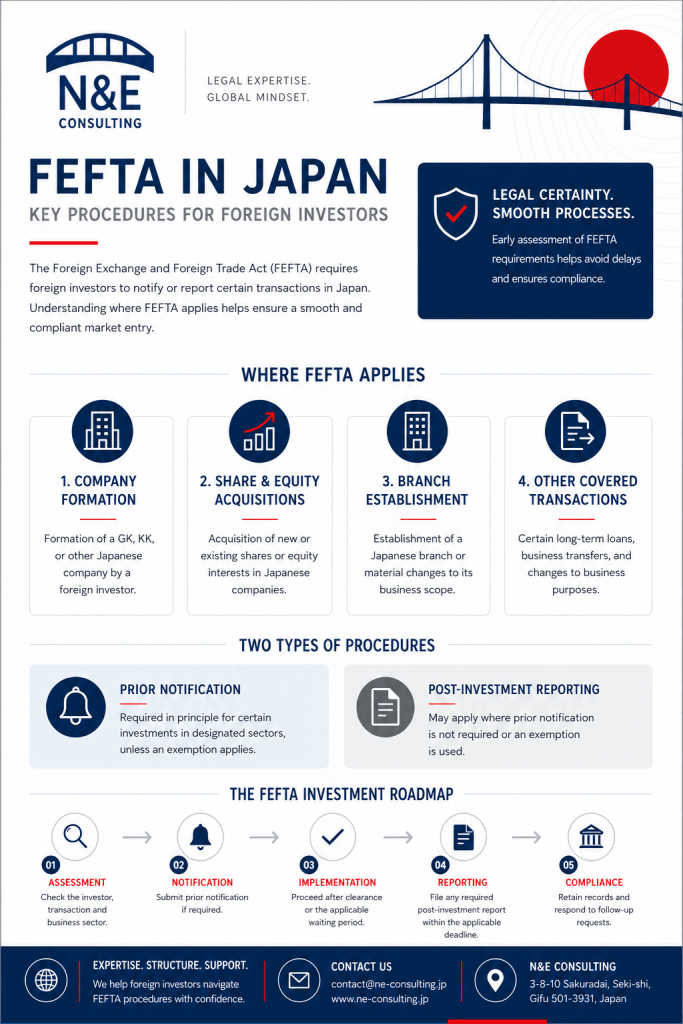
Prior Notification or Post-Investment Report? Understanding Japan’s FEFTA Rules
What Foreign Founders and Investors Need to Check Before Establishing or Investing in a Japanese Company
Establishing or investing in a company in Japan is generally based on the principle of free foreign investment. However, certain transactions must be reviewed under Japan’s Foreign Exchange and Foreign Trade Act (FEFTA) before they are carried out.
For foreign founders, this issue can arise earlier than expected. The planned business activities, the investor’s status, the ownership structure and the role the investor will take in the company may determine whether a prior notification is required, or whether a post-investment report is sufficient.
The key point is simple: FEFTA should be checked before the incorporation or investment timeline is finalized, not after the relevant transaction has already taken place.
1. What Is FEFTA?
The Foreign Exchange and Foreign Trade Act regulates certain cross-border transactions and investments involving Japan.
Japan remains open to foreign investment. At the same time, FEFTA allows the authorities to review investments that may affect national security, public order, public safety or the smooth functioning of the Japanese economy.
Where a prior notification is required, the Ministry of Finance and the ministry responsible for the relevant business sector review the planned transaction before it can proceed.
2. Who Is Considered a Foreign Investor?
The answer is not determined by nationality alone.
Foreign investors under FEFTA may include:
- individuals who are non-residents of Japan
- companies or organizations established under foreign law
- Japanese companies in which foreign investors directly or indirectly hold at least 50% of the voting rights
- certain partnerships and Japanese entities controlled by foreign persons
This distinction matters in practice. A foreign national who is resident in Japan is not automatically treated as a foreign investor solely because of nationality. Conversely, a Japanese national living outside Japan may qualify as a foreign investor.
The investor’s residence, legal form, ownership and control structure must therefore be reviewed individually.
3. Why Can FEFTA Matter During Company Formation?
FEFTA is not limited to the purchase of shares in an existing company.
The acquisition of shares or equity in an unlisted Japanese company, including shares issued when a company is established, can fall within the foreign investment reporting system. Certain other actions, such as establishing a Japanese branch, providing qualifying long-term loans or making significant changes to a company’s business purpose, may also be relevant.
For a foreign founder, this means that the FEFTA assessment should form part of the incorporation planning.
The review should consider:
- who will invest in the company
- where the individual investor resides or where the corporate investor is established
- the direct and indirect ownership structure
- the company’s intended business activities
- whether the founder or a related person will become a director
- whether the investor will have access to non-public technical information
Not every foreign-funded company formation requires a prior notification. However, the question should be checked before the relevant investment is implemented.
4. When Is Prior Notification Required?
Prior notification is required in principle when a foreign investor makes a covered investment in a Japanese company operating in a designated business sector, unless a specific exemption is available.
The designated sectors include areas such as:
- cybersecurity-related services, software and certain information-processing activities
- telecommunications and critical infrastructure
- electricity, gas, water supply and railways
- semiconductors and semiconductor-manufacturing equipment
- advanced electronic components and storage batteries
- aircraft, drones, space, weapons and dual-use technologies
- pharmaceuticals for communicable diseases and certain medical devices
- critical minerals, machine tools and industrial robots
- maritime and aviation transportation
Some designated sectors are classified as core business sectors because they are considered particularly sensitive from a national-security perspective. Exemptions are more restricted in these areas.
For unlisted companies, the acquisition of even one share can be relevant. There is no general minimum ownership threshold that automatically removes every investment in an unlisted company from the prior-notification analysis.
The company’s activities must be classified carefully. A general description such as “consulting,” “IT” or “software” is not always sufficient to determine the result. The actual services, technologies, customers and intended use may matter.
5. Prior Notification, Exemption or Post-Investment Report?
There are three possible outcomes in many cases:
- Prior notification is required. The investment must not be implemented until the applicable waiting period has ended or the authorities have shortened it.
- An exemption from prior notification is available. The investor must satisfy and continue to observe the relevant exemption conditions, and a post-investment report may still be required.
- The business falls outside the designated sectors. A post-investment report may apply instead, depending on the type and scale of the transaction.
The exemption system should not be treated as an automatic solution for active founders. Important exemption conditions may require the investor and related persons not to become board members, not to propose the disposal of designated-sector businesses and not to access certain non-public technical information.
A founder who intends to manage the Japanese company directly may therefore be unable to rely on an exemption that is designed primarily for passive investment.
6. How Does Prior Notification Affect the Timeline?
Prior notifications are submitted through the Bank of Japan to the Ministry of Finance and the competent ministry. A foreign investor generally submits through a resident agent in Japan.
Once a notification has been accepted, the statutory investment-prohibition period is generally 30 calendar days. The period may be shortened where the authorities determine that the transaction does not present the relevant risks, while more complex reviews can take longer.
According to the Ministry of Finance’s FY2025 annual report, approximately 25% of prior notifications were screened within five business days and approximately 67% within two weeks. These figures are useful for planning, but they do not guarantee a particular review period for an individual case.
For a company formation, the FEFTA review should therefore take place before the intended incorporation date is fixed. Discovering the requirement too late can delay the capital and registration schedule.
7. Why the Business Purpose Should Be Reviewed Early
The business purpose in the Articles of Incorporation is not merely a formal registration item. It describes the activities the company is legally established to conduct and can be relevant to the FEFTA classification.
Business purposes that are too broad, unclear or inconsistent with the actual business model can create avoidable uncertainty. At the same time, an artificially narrow wording should not be used to disguise activities the company genuinely plans to perform.
A sound review aligns:
- the Articles of Incorporation
- the actual business model
- any licensing requirements
- the FEFTA sector classification
- the planned incorporation and investment timeline
This coordination is particularly important for technology, software, infrastructure and advanced-manufacturing businesses.
8. What Changed in 2026?
Japan is further strengthening its foreign investment screening framework.
An amendment to FEFTA was enacted on May 29, 2026 and promulgated on June 5, 2026. Among other changes, it is intended to:
- bring certain indirect investments within the screening framework
- address domestic investment activities controlled or strongly influenced by specified high-risk foreign persons
- introduce additional measures for certain risks involving non-designated business sectors
- formalize risk-mitigation measures and strengthen cooperation among government authorities
As of August 2026, the inter-ministerial cooperation provision is already in force. The main remaining provisions will take effect on a date specified by Cabinet Order no later than one year after promulgation, with important details to be set out in subordinate legislation.
Foreign investors should therefore check the rules that apply at the time of their actual transaction rather than relying on an earlier assessment.
9. How N&E Consulting Can Support You
At N&E Consulting, we support foreign founders and international companies in coordinating the legal, administrative and practical aspects of entering the Japanese market.
Our FEFTA-related support can include:
- reviewing the investor and ownership structure
- examining the planned business activities and business purposes
- assessing whether prior notification or post-investment reporting may apply
- preparing and submitting the required notification or report
- coordinating the FEFTA procedure with the company incorporation timeline
Because the outcome depends on the specific investor, business sector and transaction, each case requires an individual assessment.
Conclusion
FEFTA is not relevant only to large corporate acquisitions. It may also affect the establishment of a new Japanese company by a foreign founder.
The correct procedure may be a prior notification, an exemption combined with post-investment reporting, a post-investment report only—or no filing for the particular transaction. The result cannot be determined from nationality or a general business label alone.
Reviewing the issue early helps avoid delays, reporting failures and changes to the incorporation schedule.
👉 Contact us before establishing or investing in a Japanese company if you would like us to review the FEFTA requirements and coordinate the necessary procedure.
This article provides general information as of August 2026 and does not constitute legal advice. Applicable requirements depend on the facts of each case and may change through legislation, subordinate regulations or administrative guidance.