
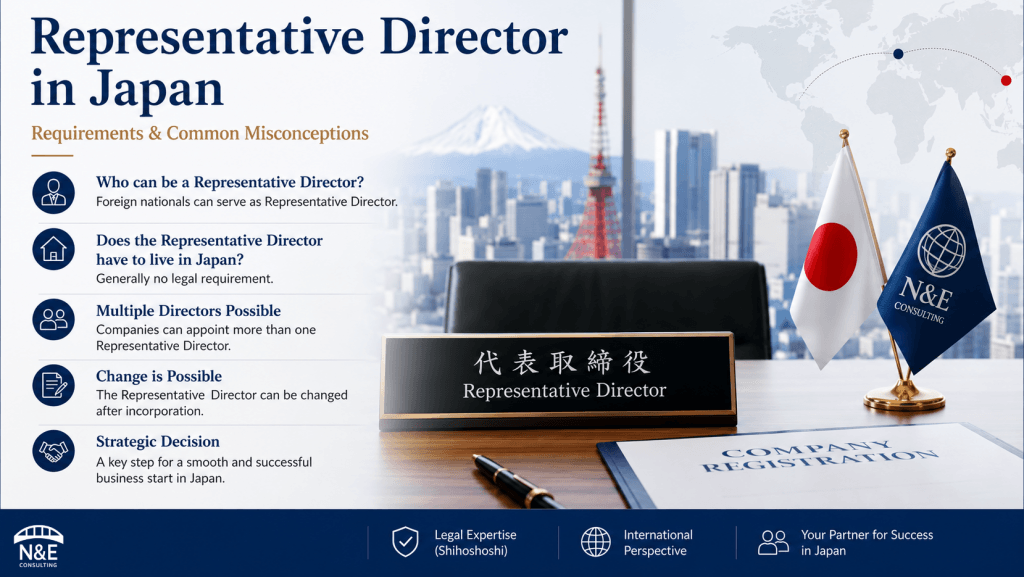
Representative Director in Japan: Requirements and Common Misconceptions
Understanding one of the most important decisions when establishing a company in Japan
When foreign entrepreneurs plan to establish a company in Japan, one question comes up almost every time:
“Who can become the Representative Director?”
Many assume that the representative director must be a Japanese citizen or live permanently in Japan. Others believe they need to hire a local nominee before they can register their company.
The reality is more nuanced.
This article explains the legal requirements, common misconceptions, and practical considerations when appointing a Representative Director in Japan.
What Is a Representative Director?
The Representative Director (代表取締役, Daihyo Torishimariyaku) is the individual who has the legal authority to represent the company.
They can, for example:
- Sign contracts on behalf of the company
- Open corporate bank accounts
- Deal with government authorities
- Represent the company before customers and business partners
- Make legally binding decisions
For many foreign businesses, this position becomes the key point of contact during the incorporation process and the early stages of business operations.
Does the Representative Director Have to Be Japanese?
No.
Japanese nationality is not required.
A foreign national can serve as Representative Director of a Japanese company.
This makes Japan comparatively open to international entrepreneurs wishing to establish a local presence.
Does the Representative Director Have to Live in Japan?
This is one of the most common misunderstandings.
Legally, there is generally no requirement for the Representative Director of a Kabushiki Kaisha (KK) or Godo Kaisha (GK) to reside in Japan.
However, while incorporation itself is possible, practical considerations often arise after registration.
For example:
- Opening a corporate bank account
- Receiving official correspondence
- Handling administrative procedures
- Managing day-to-day communication with authorities and business partners
These practical aspects should be considered early in the planning process.
Can There Be More Than One Representative Director?
Yes.
A company may appoint multiple directors, depending on its corporate structure.
For international businesses, this can provide additional flexibility by distributing responsibilities between headquarters and Japan.
The most suitable structure depends on the company’s business model, governance, and long-term plans.
Can the Representative Director Be Changed Later?
Yes.
Many international companies appoint an initial Representative Director during incorporation and later change the appointment as the business grows.
Typical situations include:
- Expansion of the Japanese business
- Relocation of senior management
- Appointment of a local executive
- Organizational restructuring
The change must be properly registered with the Legal Affairs Bureau.
Common Misconceptions
“The Representative Director must be a Japanese citizen.”
False.
Foreign nationals may serve as Representative Directors.
“I need a Japanese nominee before I can establish my company.”
Not necessarily.
Whether a local representative is beneficial depends on your individual circumstances rather than a general legal requirement.
“Once the company is registered, everything is finished.”
Unfortunately, no.
Company registration is only the beginning.
Depending on your business, the next steps may include:
- Corporate bank account opening
- Tax registration
- Social insurance procedures
- Business licenses (if applicable)
- Visa applications
- Ongoing corporate compliance
Proper planning before incorporation helps avoid unnecessary delays later.
Practical Considerations for Foreign Companies
Every international business enters the Japanese market with different objectives.
Some establish a subsidiary for long-term operations.
Others create a sales office, support local customers, or prepare for future expansion.
For this reason, the appointment of a Representative Director should always be considered together with questions such as:
- Which legal structure is most appropriate?
- Who will manage the Japanese operations?
- How will banking and administration be handled?
- Are visas required?
- What are the long-term business plans?
Looking at these questions as part of a single strategy usually leads to a smoother market entry.
How We Support International Clients
At N&E Consulting, we support foreign companies throughout the entire company formation process in Japan.
Together with licensed Shihoshoshi legal services, we assist clients with:
- Choosing the appropriate legal structure
- Company incorporation
- Corporate registration procedures
- Coordination of required documentation
- Visa-related support
- Practical guidance throughout the market entry process
Our goal is not only to complete the registration but to help clients establish a solid foundation for doing business in Japan.
Final Thoughts
Choosing a Representative Director is more than completing a registration form.
It is one of the first strategic decisions that influences how efficiently your business can begin operating in Japan.
Understanding both the legal framework and the practical realities helps avoid unnecessary complications and allows your company to focus on what matters most—building a successful business.
If you are planning to establish a company in Japan and would like professional guidance throughout the process, N&E Consulting is here to support you with bilingual legal and business expertise.