
Starting a Business in Japan
Legal & Administrative Steps Explained
Starting a business in Japan offers significant opportunities for foreign companies. At the same time, the process is often more structured, formalized, and segmented than many expect.
One of the key challenges is that different aspects of the process are handled by different licensed professionals. Without a clear understanding of these roles and their interaction, delays or inefficiencies can easily occur.
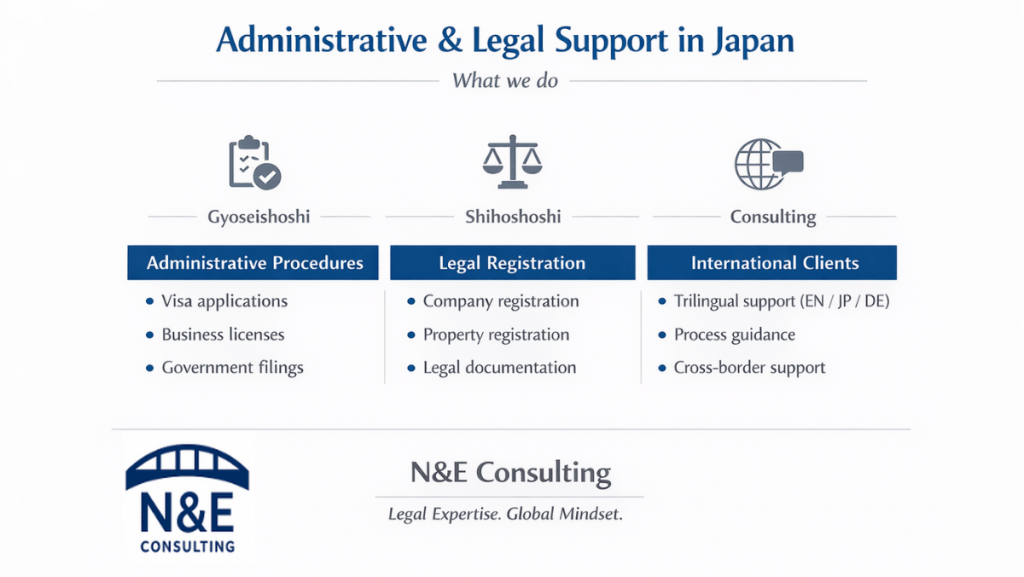
1. Administrative Procedures (Gyoseishoshi)
Administrative procedures typically form the first layer of the setup process.
This includes:
- Visa applications (for founders, directors, or employees)
- Business licenses and permits (depending on the industry)
- Notifications and filings with government authorities
These procedures are highly document-driven. Requirements vary depending on the business model, nationality of the founders, and planned activities in Japan.
In practice, incomplete or inconsistent documentation is one of the most common causes of delays. Ensuring accuracy and compliance at this stage is therefore critical.
2. Legal Registration (Shihoshoshi)
Once the administrative foundation is in place, legal registration becomes the central step.
This primarily includes:
- Company incorporation (e.g., GK or KK structures)
- Registration at the Legal Affairs Bureau
- Preparation and submission of official legal documents
Depending on the business setup, additional steps such as property registration may also be relevant.
A key aspect is that these procedures require legal authority and must be handled by licensed professionals. The registration itself establishes the legal existence of the company in Japan.
3. Structuring & Coordination (Consulting Perspective)
While each individual step is important, the main complexity usually lies in the coordination between them.
Typical questions include:
- In which order should processes be initiated?
- How do visa requirements align with company setup?
- What timeline is realistic for market entry?
Without a structured approach, processes can overlap inefficiently or create unnecessary delays.
From a consulting perspective, the goal is to align all elements:
- administrative procedures
- legal registration
- operational planning
This ensures a smoother and more predictable setup process.
4. Typical Challenges for Foreign Companies
Foreign companies entering Japan often face similar challenges:
- Limited transparency of procedures
- Language barriers in documentation and communication
- Different expectations regarding timelines and formalities
- Fragmentation between administrative and legal processes
Understanding these factors early on can significantly reduce risk and uncertainty.
Conclusion
Setting up a business in Japan requires more than completing individual procedures. It requires understanding how administrative, legal, and operational elements interact.
At N&E Consulting, we combine these perspectives to provide structured support for international clients—bridging legal requirements, administrative processes, and practical implementation.